


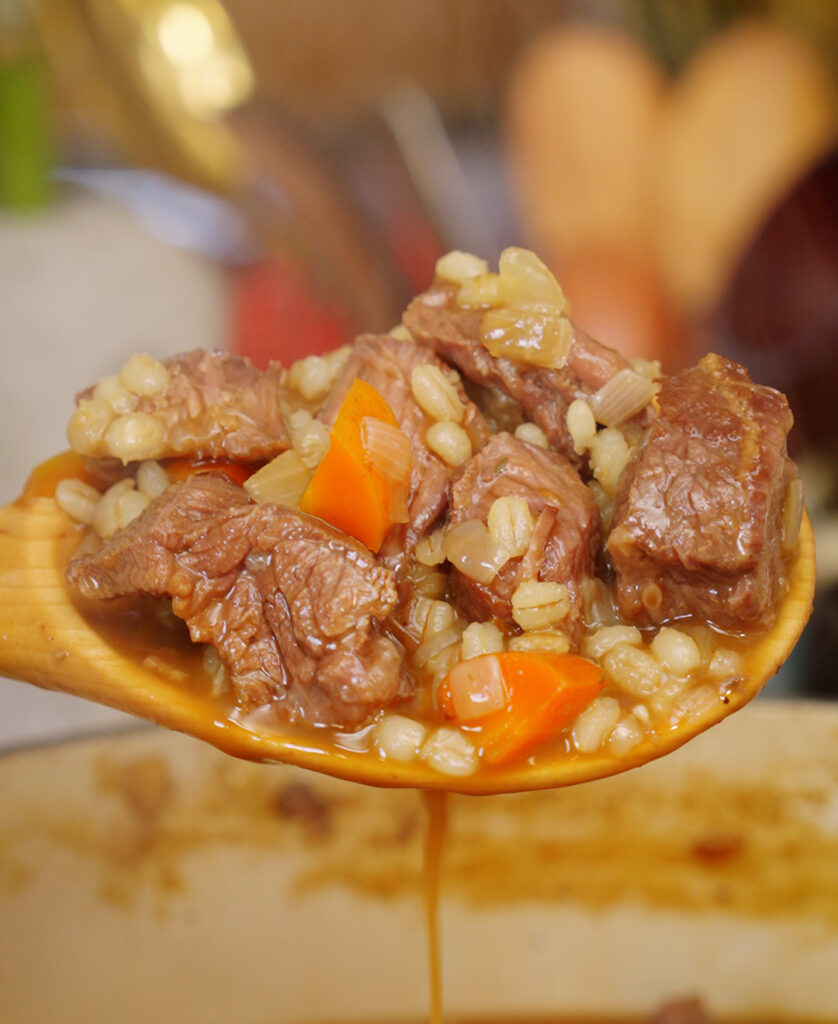
This beef and barley soup recipe is one of my family favorites. It’s been with me since childhood where I spent a lot of time with my Bubbie (Grandmother). Growing up, she would always make this wonderful beef and barley soup that became kind of a coveted item at my dad’s house.
Below is a section on tips for browning your meats, followed by a social video and a full recipes breakdown, complete with notes, mods, macros and more.
Cheers,
Joey
I spent a lot of time with my Bubbie growing up and she would always make this wonderful beef barley soup that became kind of a coveted item at my dad’s house.


It’s the soup that eats like a stew! It’s chunky yet brothy with it’s distinct flavor from the mirepoix base.
🥩 Cutting your meat into larger 1 1/2” chunks results in the perfect size once cooked and helps to avoid overcooking your meat.
🥕A mire poix of carrots, onions and celery brings a classic flavor base while adding fish sauce adds a depth of flavor.
🥶 Make extra to freeze: While this recipe makes a TON you will go through it quicker than you might expect. If your heart is set on left overs be like my Bubbie and make extra.
🔥 Browning Your Meat
Taking the time to brown your meat properly at the start of cooking makes a huge flavor difference in the long run. The browning on the meat itself is very flavorful and the fond that it leaves on the base of your pan is also full of flavor once you deglaze it into your soup. Proper browning is crucial for the best beef and barley soup results.
Buy 1 large piece of boneless chuck roast and cut it down into 1 1/2 inch thick steaks. This allows you to increase the surface (and develop more flavor) while not making the pieces too small that they will overcook.
Season your meat well with salt and pepper a few hours before. Even overnight if you can. Pat your meat down with a paper towel before browning to help dry the surface of the meat.
Get a solid set of short steel kitchen tongs that you are comfortable handling. Steel tongs are ideal because you can really grab your meat well and orient it as you need to. Larger cuts of meat can also be heavy. Steel tongs are great at handling them.
Use a neutral oil and a cast iron, carbon steel skillet, pan, or dutch oven. Stainless will also work just fine if that is what you have on hand. Use the largest burner on your stovetop and heat your oil until it’s lightly smoking. Wait a moment and then add in your steaks. Add 1 or 2 at a time, making sure not to overcrowd the pan. Otherwise, this will steam your meat versus sear it. Press the steaks firmly into the pan to ensure even contact.
Using a weighted element like a heavier grade chef’s press will help to ensure even contact and promote quicker and more even browning. You can also use a piece of parchment paper and the base of another pan to weigh it down or something similar.
Don’t overdo it with the turning and keep it to about 4 or 5 minutes on each side. Make sure to give the narrow ends a quick sear as well. You can use your tongs to help hold your steaks for those parts.
And thats about it! Once your meat is well browned on all sides you can remove it from the pan and set aside for later. For my families beef and barley soup recipe, we’re slicing it down into cubes and using the fond we’ve just created in the bottom of our pan to start building our soup. Yummy!
Parmesan rinds are such a flavor bomb to add into your brothier endeavors! I use parmesan a ton in my cooking and think that having a wedge around is such a useful tool for quickly adding flavor and texture to your dishes.
I guess you could also title this section ‘the case for a full wedge of parmesan’ vs pre-ground because there’s the other part to it which is that having a parmesan wedge gives you the ability to shave it, grate and micro grate it depending on what you wnt to do with it! But I digress…
So, given that you can use a TON of parmesan if your day to day meals, you’re going to eventually end up with a bunch of parmesan rinds. When this happens, do no throw them away because they are the gift that keeps on giving.
In their second life, parmesan rinds can give a wonderful flavor bump to soups, stews and any other more liquid heavy dishes and recipes. You simply just add it in and let it sit and do it’s thing. Don’t agitate it too much and remove it after and hour or so once it’s spent.
I recommend a freezer solution like a ziplock freezer bag so that when you have a rind ready to go you can simply toss it in the bag until you need it. They will pretty much last indefinitely if properly stored though I’m not positive how long that actually is!
🎥 Youtube Video

More recipes and videos on my Youtube HERE. Including detailed steps on how to make our family recipe for beef and barley soup.
🔁 Recipe Modifications
- You can substitute chuck roast for something fancier like beef short ribs for a deeper and beefier flavor but they will also be much more expensive.
- You can also ask for some beef bones from your local butcher to add to the soup while it cooks for deeper flavor. These will either be free or dirt cheap!
- Use the best quality beef stock you can find, ideally a bone broth. This can also get a bit expensive so you can alternatively use a high quality chicken stock which will also work very well.
Leave a Reply Cancel reply